Explore
TOP ACTIVITIES




Manage
Support
GET THE APP

These are four places across campus where that calm is most concentrated. A mosque that feels like the future. A library where you can see a 15th-century map and hear your own breathing. A botanic garden that reads like scripture made visible. A park that transforms after sunset into something you’ll want to photograph, and then put your phone away for. They’re all free. They’re all connected by a tram you don’t have to pay for. And none of them needs a plan, just a willingness to slow down for an hour or two.
A four-storey ablution cascade runs beneath the mosque, cooling the space before you go in.
The prayer hall is raised above the ground. Visitors are welcome outside prayer times.
Five pillars hold the building up, one for each pillar of Islam.
Two minarets rise 90 metres into the sky and point directly toward Makkah. They’re wrapped in vertical calligraphy designed by Iraqi architect and calligrapher Taha Al Hiti, Arabic script that sweeps upward like a prayer made visible. The building beneath them, designed by Mangera Yvars Architects, is suspended on five pillars, each representing one of the pillars of Islam. It won the World Architecture Festival’s Best Religious Building prize in 2015, and when the Royal Institute of British Architects nominated it for their inaugural international prize the following year, nobody who’d been inside was surprised.
But the awards don’t capture what it actually feels like to walk in. The prayer hall is elevated above the ground, which gives the building a sense of weightlessness, a feeling of spiritual ascension that the architects intended and the light delivers. Beneath the mosque, a four-storey ablution cascade channels water downward, cooling the space and marking the transition from the everyday world to the sacred one. Outside, four streams carry water to a central garden, representing the four rivers of Paradise described in the Qur’an: water, honey, milk and wine.
The spiral building plan connects the College of Islamic Studies to the mosque through multiple pathways, a spatial argument that all knowledge ultimately derives from faith. It’s the kind of architectural idea you can feel before anyone explains it to you. You enter expecting a mosque and leave having experienced something closer to a meditation on what a modern place of worship can be.
Admission
Free. Open to all visitors outside prayer times
Dress code
Modest dress required. Women should cover hair, arms and legs
Best moment
Late afternoon, when the calligraphy catches golden light
Getting there
Yellow Line tram, Minaretein stop. About 5 minutes from Oxygen Park, 10 minutes from QNL
Don’t miss
The four streams outside and the ablution cascade beneath the prayer hall
Terraced shelves rise from the floor, and more than a million books sit in view.
Upstairs, the reading floors are quiet. Nobody’s rushing you.
Long study tables run beneath the sloping roof, in daylight from the glass.
Rem Koolhaas designed Qatar National Library to answer a question he’d been carrying since 1989: do we still need libraries? Walk in, and the answer is obvious. The 45,000-square-metre building is conceived as a single open room. Three aisles of terraced bookshelves rise from the ground like geological formations, and from almost anywhere inside you can see the entire collection, over a million books, spread around you, daylight diffusing through the diamond-shaped glass façade into something gentler.
The peaceful escape is at the centre. Sunk six metres below the reading floor and clad in beige travertine, the Heritage Library looks and feels like an archaeological excavation. Inside, climate-controlled cases hold the 1478 Ptolemy map of Arabia, the first printed map in history to mention Qatar, spelled “Catara” in Latin. A 4.35-metre Ottoman strip map traces the Tigris and Euphrates from their origins to the Gulf. Qur’anic manuscripts from China sit alongside scientific instruments and the Cedid Atlas Tercümesi, one of the rarest Ottoman atlases in the world. It’s not a museum, but it stops you the way one does.
Upstairs, the reading floors have the quality of a place where time works differently. Grab a coffee at Safahat on the ground floor (the rainbow latte is a local favourite), find a seat in one of the bubble chairs, and let the building do what Koolhaas designed it to: make you want to stay. Nobody’s rushing you. The Wi-Fi is fast, the light is beautiful, and the quiet isn’t enforced. It’s earned.
Admission
Free entry for everyone. Free membership with Qatar ID
Hours
Saturday to Thursday, 8am to 8pm. Friday, 4pm to 8pm
Best moment
Early morning, when the façade light is softest and the reading floors are quiet
Getting there
Green Line Metro to QNL station (1 minute walk). Yellow Line tram, Multaqa stop
Don’t miss
The Heritage Library: 30 minutes that will stay with you
The minarets show through the branches as you walk under the trees.
More than 60 plants named in the Qur’an and the Sunnah grow here, from olives and figs to jasmine.
Under the canopy the air is cooler. Find a bench in the shade and stay a while.
There’s a garden in Education City where every plant tells a story older than the buildings around it. The Qur’anic Botanic Garden, the first of its kind in the world, cultivates the plants mentioned in the Holy Qur’an and the Sunnah of the Prophet. Olives, figs, pomegranates, date palms, basil, jasmine: over 60 species growing in themed sensory gardens, each designed around a different way of experiencing the natural world.
The Scent Garden lets you crush a leaf between your fingers and carry the smell with you. The Desert Garden reconstructs Qatar’s native Rawdat ecosystem, with the iconic Sidra tree, the same species Her Highness Sheikha Moza bint Nasser planted as the garden’s first seedling in 2008, and the symbol of Qatar Foundation itself. The Water Garden provides seating beside running channels. The Botanical Museum inside uses hologram technology to bring Qur’anic verses about plants to life. It’s education, conservation and contemplation woven into the same afternoon walk.
Next to the Education City Mosque, the garden is best experienced as a pair: the architecture of faith above, the living evidence of creation below. The minarets are visible through the branches, and the effect is striking, a kind of continuity between the designed and the grown, the built and the planted. Come with curiosity or come with faith. Either way, you’ll leave knowing something about the plants that have shaped a civilisation’s relationship with the natural world.
Admission
Free entry for everyone, every day
Best moment
Late afternoon in cooler months, when the light filters through the tree canopy
Getting there
Yellow Line tram, Minaretein stop. Next to the Education City Mosque
Pair with
The Education City Mosque. You can walk between the two in under 5 minutes
Don’t miss
The Sidra tree and the Scent Garden, the kind of detail you carry home
In the cooler months, walk the shaded paths as the temperature drops.
When the light softens, the balloon-shaped lamps come on.
After dark, the waterfalls are lit from below.
Oxygen Park is 130,000 square metres of green in a desert city, and that alone would be enough. But AECOM’s design team, led by Erik Behrens and landscape architect James Haig Streeter, studied Qatar’s wind-eroded rock formations and built a park that moves like the land itself. The ground undulates, rises into covered walkways, folds into sunken sports bowls and opens into flat meadows. It won the IAKS Silver Award in 2019 for good reason. But the award isn’t the point. The point is what happens at 5pm.
That’s when the light softens and the park becomes a different place. The balloon-shaped lamps come on. The waterfalls are lit from below. The illuminated tunnels glow, and the eastern recreation zone, with its themed gardens, amphitheatre and grassy mounds, shifts from active to atmospheric. It’s the side of the park that visitors photograph and post about, and the reason the park fills up after sunset, not before.
For the peaceful escape, arrive around 4:30pm in the cooler months. Walk the shaded pathways as the temperature drops. Sit on a grassy mound and watch the sky change. When the lights come on, keep walking: the cascading waterfalls over the air-conditioned promenade edges catch the light beautifully. Bring a picnic blanket and something to eat (there’s no restaurant, and that’s part of the charm). The park closes at 9pm, and the underground parking keeps your car cool while you’re out. It’s the simplest, most restorative evening in Doha, and it costs nothing.
Admission
Free entry for everyone, every day. Open 6am to 9pm
Best moment
Arrive at 4:30pm in cooler months and stay through sunset and the lights
Getting there
Yellow Line tram, Oxygen Park station. Underground parking P3, 6am to 10pm
Bring
Water, a picnic blanket, a camera and patience with the sunset
Don’t miss
The lit walkways and waterfalls after dark, Doha’s best-kept evening
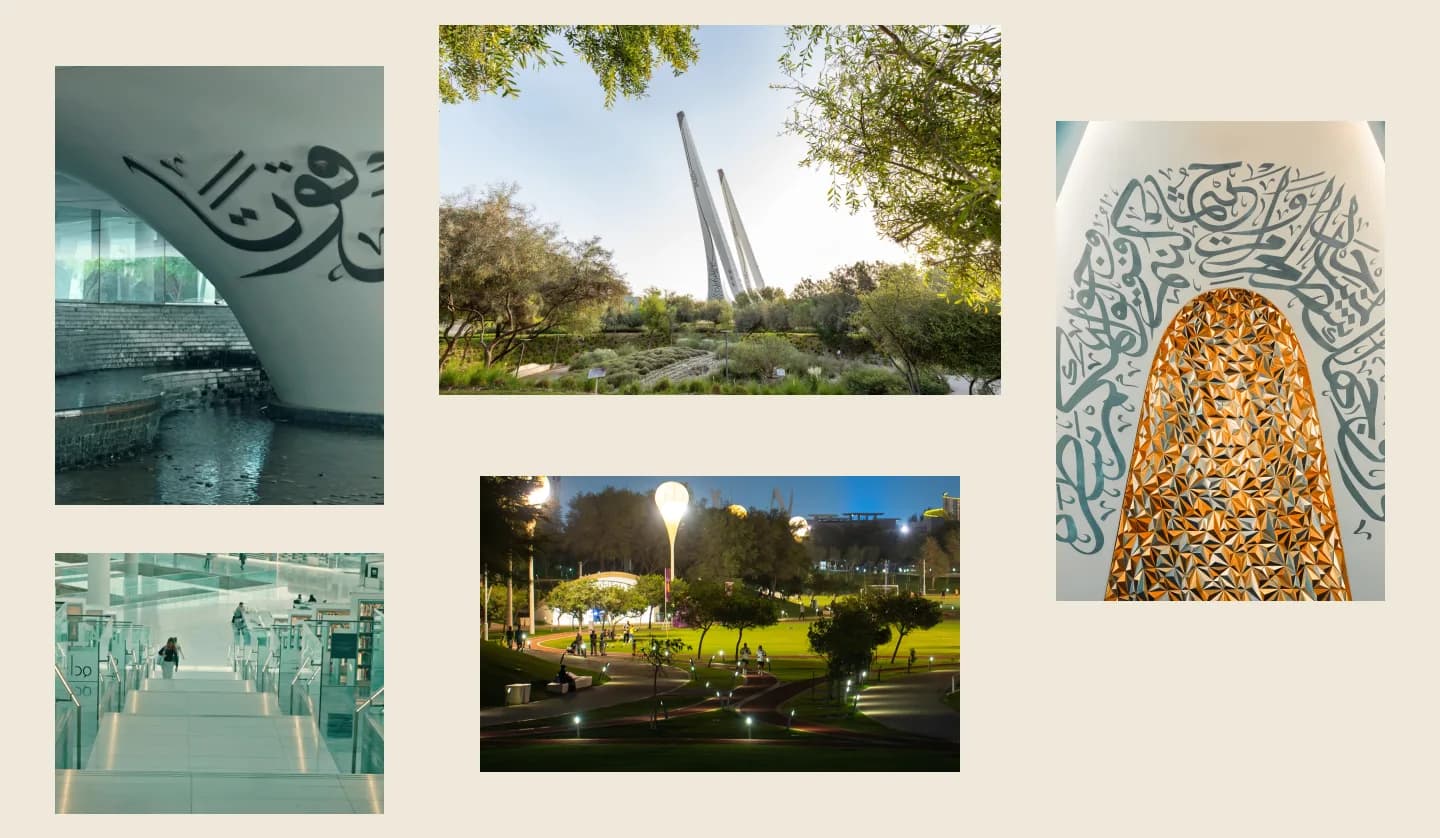
Details from the mosque, the library, the Qur'anic Botanic Garden and Oxygen Park
All four escapes in one afternoon. Allow 4 to 5 hours. Best on a Saturday or Thursday, October to March.
2pm · Qur’anic Botanic Garden
Start where the pace is slowest. Walk the sensory gardens, find the Sidra tree and let the afternoon settle in. Allow 45 minutes.
2:45pm · Education City Mosque
Walk over from the garden, they’re next to each other. See the four streams and the courtyard first, then step inside outside prayer times. Allow 30 to 45 minutes.
3:30pm · Qatar National Library
Take the Yellow Line tram from Minaretein to Multaqa, about 10 minutes. Head for the Heritage Library, then find a seat and a coffee at Safahat. Allow 60 to 90 minutes.
5pm · Oxygen Park
Take the Yellow Line tram from Multaqa to Oxygen Park, about 10 minutes. Walk the eastern gardens and watch the lamps come on. The park closes at 9pm.
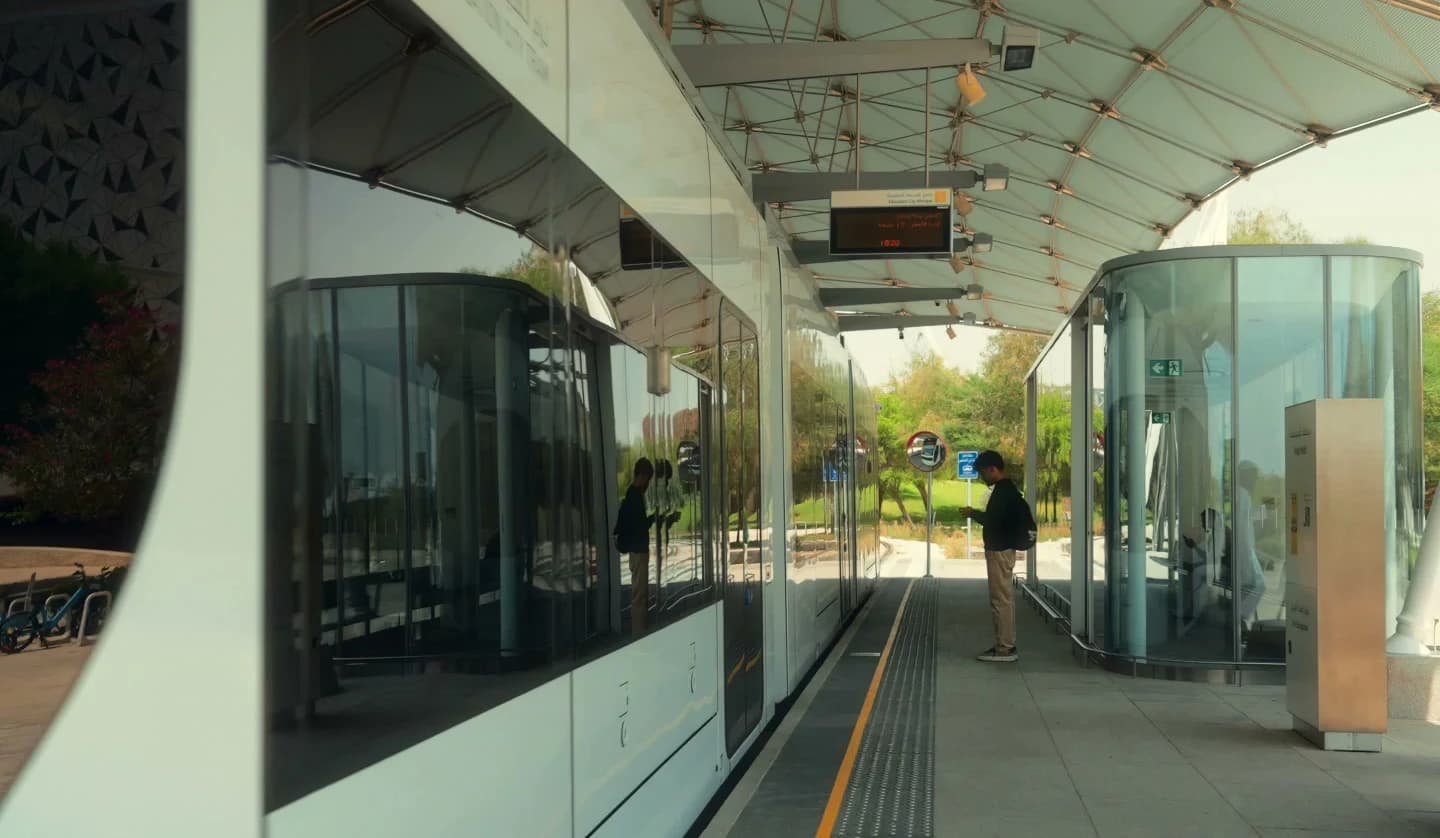
The free EC Tram arriving at a stop on campus
Every stop is free, and so is the tram.
Botanic Garden to the mosque
Next to each other, a short walk
Mosque to QNL
About 10 minutes on the Yellow Line, Minaretein to Multaqa
QNL to Oxygen Park
About 10 minutes on the Yellow Line
Oxygen Park to the mosque
About 5 minutes on the Yellow Line
Total cost: nothing. Total tram time: about 20 minutes. Total distance: one campus.